
GAP insurance remains one of the most important F&I products a dealership can offer, especially as vehicle prices, loan terms, and loan-to-value ratios continue to rise. For finance managers, GAP is not just a product—it’s a protection tool that helps customers avoid financial hardship while supporting smoother deals and stronger lender relationships.
This article explains how expansive GAP insurance coverage benefits both buyers and dealerships, and why flexible GAP options are critical in today’s F&I environment.
What GAP Insurance Is Designed to Do
GAP (Guaranteed Asset Protection) covers the difference between a vehicle’s actual cash value paid by an insurance company and the remaining loan or lease balance after a total loss. Because vehicles depreciate quickly, many buyers find themselves owing more than their insurance payout covers.
Without GAP, that difference becomes an out-of-pocket expense for the buyer—often thousands of dollars. With the right GAP coverage in place, customers are protected from that financial exposure.
For finance managers, GAP helps ensure customers leave the dealership fully protected, not financially vulnerable.
Why GAP Is a Core F&I Product
GAP insurance supports several key goals at the F&I desk:
- Protects buyers from unexpected financial loss
- Reduces post-loss complaints and customer frustration
- Helps lenders feel more secure in higher-risk structures
- Supports cleaner, more confident deliveries
- Builds trust through protection, not pressure
When GAP is presented clearly and matched to the deal structure, customers see it as responsible protection rather than an upsell.
Expansive GAP Coverage That Matches Today’s Deals
Many GAP programs are limited in scope, which can leave gaps—especially on higher LTV deals or specialty vehicles. Expansive GAP options give finance managers the flexibility they need to protect more buyers across more deal types.
Coverage options include:
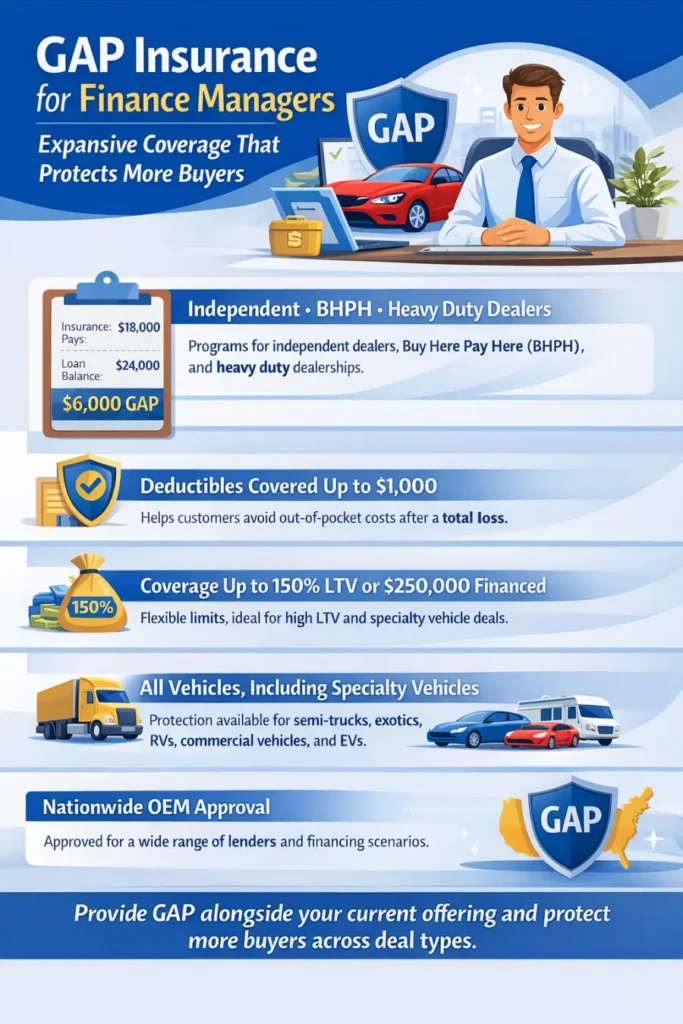
- Programs available for Independent dealers, Buy Here Pay Here (BHPH), and Heavy Duty dealerships
- Deductible coverage up to $1,000, reducing out-of-pocket costs for customers
- Coverage up to 150% LTV or $250,000 financed, supporting modern loan structures
- Eligibility for all vehicle types, including semi-trucks, exotics, commercial vehicles, EVs, and RVs
- Nationwide OEM approval, supporting a wide range of lender and financing scenarios
This level of flexibility allows finance managers to confidently protect buyers who may otherwise fall outside standard GAP guidelines.
How GAP Helps Finance Managers Do Their Job Better
Finance managers are often balancing lender requirements, customer concerns, and deal structure limitations. A strong GAP program helps by:
- Supporting higher LTV approvals
- Protecting customers on longer terms
- Reducing objections tied to risk and uncertainty
- Making complex deals easier to structure
- Preventing post-sale financial fallout
When buyers understand that GAP protects them in real-world loss situations, the conversation becomes about responsibility and peace of mind—not fear.
GAP That Fits Your Current F&I Process
One of the most important advantages of a flexible GAP program is that it does not require a full replacement of what a dealership already uses.
If a GAP option offers:
- Higher limits
- Broader vehicle eligibility
- Better deductible handling
- Coverage for specialty or higher-risk deals
It can be added alongside an existing GAP provider. Many dealerships use additional GAP options only when needed—for example, on higher LTV deals, specialty vehicles, or lender-specific requirements.
This approach keeps the F&I process consistent while expanding the dealership’s ability to protect more buyers.
Protecting More Buyers Without Disrupting Your Store
The goal of any F&I product should be simple: protect the customer and support the dealership. Expansive GAP coverage allows finance managers to do both without changing their entire menu or retraining their process.
By offering GAP options that fill coverage gaps, dealerships can:
- Protect more customers
- Improve deal flexibility
- Strengthen lender confidence
- Maintain consistency in F&I presentation
- Support healthier back-end performance
Final Thoughts
GAP insurance remains one of the most valuable F&I products when it’s designed to match real-world deals. Expansive coverage gives finance managers the tools they need to protect buyers across a wide range of vehicles, loan structures, and lender requirements.
When GAP fits the deal—and the process—everyone wins.
For dealerships looking to expand GAP limits, improve flexibility, or add coverage options alongside what they already use, reviewing additional GAP solutions can uncover opportunities to better serve customers while strengthening F&I results.
A short conversation can often reveal ways to protect more buyers without disrupting what already works.